The ongoing conflict in Ukraine has displaced millions, many of whom have sought refuge in neighboring countries, including Georgia and Moldova. Among these displaced populations are individuals with disabilities who face distinct and often heightened challenges in their host countries.
In response to these urgent needs, a joint initiative supported by the Global Disability Fund has brought together several UN agencies, including WHO, OHCHR, UNFPA, UNICEF, UN Women and the European Disability Forum to adopt a fully inclusive approach to the refugee crisis. This collaborative effort strengthened technical capacity, promoted coordination among stakeholders, and drove humanitarian responses in line with the Convention on the Rights of Persons with Disabilities (CRPD), particularly Article 11, which safeguards the rights and safety of persons with disabilities in situations of risk and emergency. Two assessments conducted by OHCHR in Georgia and Moldova revealed the severe exclusion and discrimination faced by Ukrainian refugees with disabilities, underscoring the pressing requirement for increased targeted interventions.
The need for an inclusive and intersectional approach
Persons with disabilities are among the most marginalized during crises, and displacement often exacerbates their vulnerabilities. This is especially true for women and girls, who are at higher risk of gender-based violence and exploitation. Data from Moldova and Georgia highlight the significant barriers these refugees face, including inaccessible accommodations, limited transportation, inadequate healthcare, and exclusion from education. Despite both countries having ratified the CRPD, inclusive policies and services for refugees with disabilities remain underdeveloped, leaving them at risk of further exclusion. Moreover, not all persons with disabilities face the same risks. Multiple forms of discrimination—based on disability, gender, and age—often intersect, compounding these challenges. Refugees fleeing conflict are at increased risk of sexual violence, exploitation, trafficking. Due to martial law in Ukraine, many women, children, and older persons with disabilities are making these perilous journeys alone, further increasing their vulnerability.
Making the invisible visible
A major barrier to providing adequate support in both Moldova and Georgia is the lack of disaggregated data on refugees with disabilities. This data gap makes it difficult for humanitarian actors to offer targeted services, resulting in many refugees being systematically overlooked. It is essential that persons with disabilities are involved in every stage of the response, from planning to implementation. Their representative organizations, are key stakeholders and must be included in planning, implementing, and monitoring interventions. This programme has developed mechanisms to engage OPDs, enhancing their capacity to advocate for their communities and collaborate with governments, INGOs, and UN agencies. Since the experience of disability is not homogeneous, the voices of underrepresented groups must also be heard to ensure no one is left behind.
Challenges on the ground
In both Georgia and Moldova, refugees with disabilities face significant barriers to accessing essential services. Critical challenges include obtaining accurate and accessible information about available support, navigating complex bureaucratic processes, and financial obstacles that hinder access to healthcare, assistive devices, and other necessary services. The documentation process, especially for those holding Ukrainian identity documents, adds further difficulties. Additionally, interventions for persons with disabilities are often limited to specialized services without addressing their mainstream needs. Gaps in accessible healthcare services persist, with many refugees unaware of available treatments and medications. Rehabilitation services and the provision of assistive devices are notably lacking. Securing accessible and affordable housing also remains a major challenge. Economic instability further exacerbates these issues, with limited opportunities for employment and income generation. Financial assistance often falls short of covering the additional costs associated with disabilities. Children with disabilities face particular challenges in accessing inclusive education, with many being rejected from mainstream schools or lacking tailored educational programs. Language barriers also impede both children and adults from fully participating in educational and language-learning opportunities.
Looking Ahead: An Opportunity for Change
Despite the challenges, there is a real opportunity to build more inclusive systems in Moldova and Georgia. As the humanitarian crisis continues, it is crucial to ensure that no one is left behind. This program addressed the immediate needs of Ukrainian refugees with disabilities and aimed to create lasting change in how disability inclusion is approached in these countries. This is a pivotal moment to advance disability-inclusive humanitarian responses, protecting the most vulnerable during one of Europe’s largest refugee crises in recent history. As the conflict continues, both host countries and the international community must take concrete steps to ensure that the rights of refugees with disabilities are not overlooked and fully respected.
Download the Disability and Displacement reports
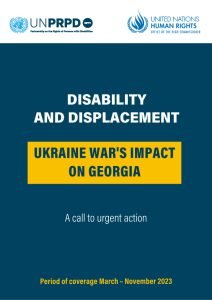

Both reports highlight the urgent need for coordinated action to address service gaps and support for refugees with disabilities. National and international stakeholders must prioritize the inclusion of refugees with disabilities in all aspects of social and economic life. Key recommendations include building local capacity and awareness on disability inclusion, ensuring that protocols and services meet the requirements of persons with disabilities, providing accessible information and services in formats like Braille and sign language, implementing disability-specific cash assistance programs, and fostering community-based support networks. Improving access to quality sexual and reproductive health services and GBV-related services, supporting inclusive education for children with disabilities, developing robust data collection systems, enhancing stakeholder coordination, advocating for policy reforms, and urging donors to allocate specific funding for disability inclusion are critical to ensuring that persons with disabilities are not excluded from the humanitarian response.